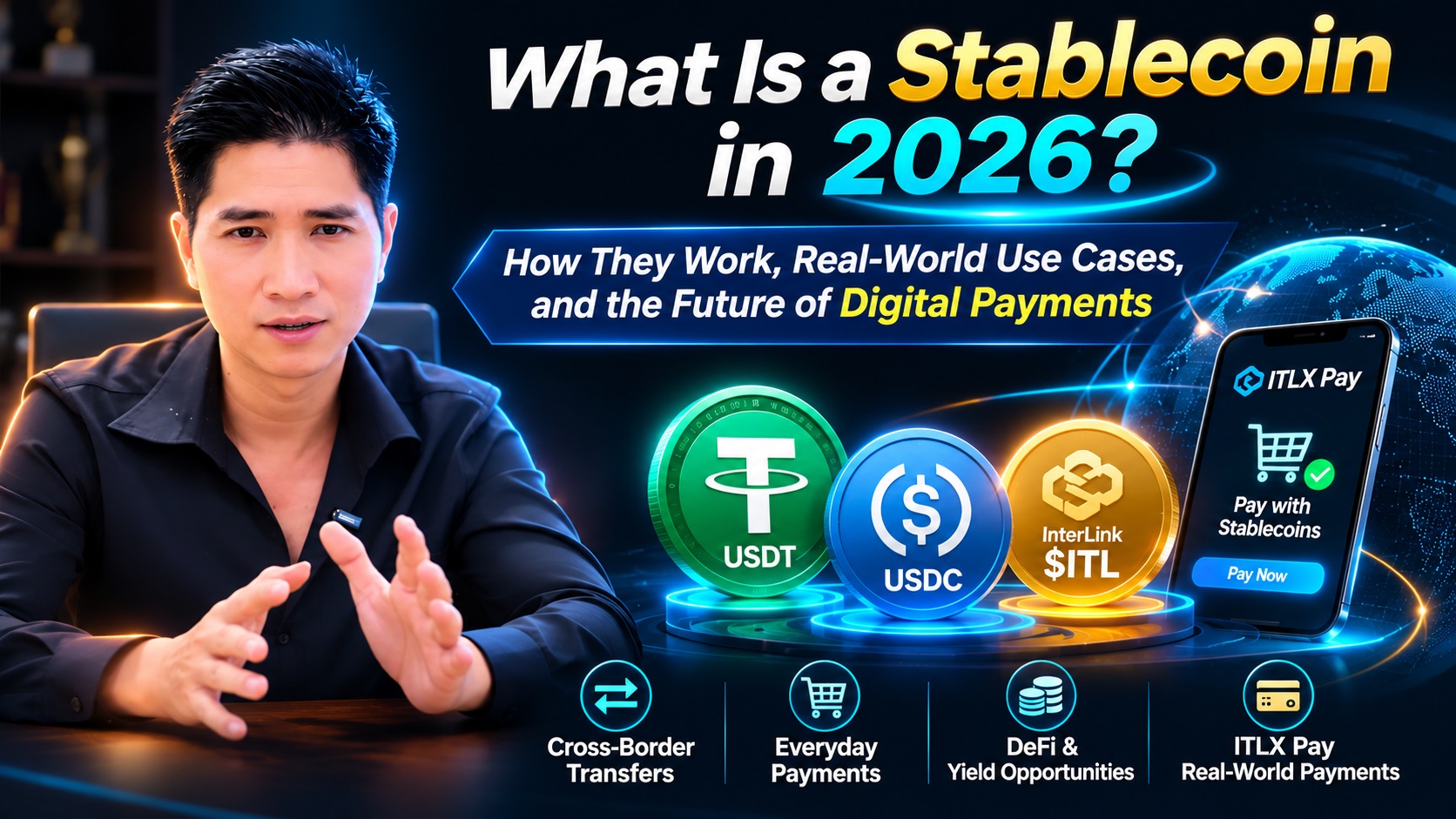
WHAT IS A STABLECOIN IN 2026? HOW THEY WORK, REAL-WORLD USE CASES, AND THE FUTURE OF DIGITAL PAYMENTS
November 12, 2026 | Technology | Blockchain & Web3
1. Stablecoins – The Essential Building Blocks of the Crypto Economy
If Bitcoin is considered the most recognized digital asset in the cryptocurrency market, Stablecoins are becoming one of the most important foundations supporting the broader crypto economy.
Bitcoin is well known for its potential price appreciation, but it is also subject to significant volatility. Ethereum, Solana, and many other digital assets can experience substantial price fluctuations within a relatively short period.
This creates an important challenge: How can cryptocurrencies be used for everyday payments if their values constantly change?
This is exactly the problem Stablecoins were designed to solve.
Stablecoins are digital assets designed to maintain a relatively stable value, typically pegged 1:1 to the US dollar. They allow users to transfer money, trade, make payments, and participate in blockchain-based financial activities without being exposed to the same level of price volatility as Bitcoin or other cryptocurrencies.
According to figures cited in the original article, the total supply of major stablecoins reached approximately $304 billion in early 2026, with USDT and USDC accounting for around 89% of the market.
This demonstrates that Stablecoins are no longer simply tools for cryptocurrency traders. They are gradually becoming a new financial infrastructure layer for the digital economy.
Real-world example:
Imagine you have $1,000 and want to preserve its value within the crypto market.
- If you convert it into Bitcoin, its value may increase or decrease significantly depending on market conditions.
- If you convert it into USDT, the goal is to maintain approximately $1,000 in value.
- If you want to transfer $1,000 worth of USDT to someone in another country, you can send it through a supported blockchain network without relying on the traditional international banking transfer process.
Of course, stablecoins still carry risks related to their price peg, issuers, blockchain networks, and transaction fees.
2. What Is a Stablecoin?
A Stablecoin is a digital asset issued on a blockchain and designed to maintain a relatively stable value against an underlying reference asset.
The most common reference asset is the US dollar.
Some of the most notable examples include:
- USDT (Tether): A widely used stablecoin commonly utilized in cryptocurrency trading.
- USDC (USD Coin): A stablecoin issued by Circle, with an emphasis on transparency and regulatory compliance.
- DAI: A decentralized stablecoin backed by on-chain collateral.
- USDe: A synthetic dollar asset developed by Ethena that uses hedging and asset strategies to maintain its target value rather than relying on a traditional cash-backed model.
Three Key Concepts to Understand
Peg – Price Pegging Mechanism
The target value that a stablecoin is designed to maintain.
Example: 1 USDT is designed to be worth approximately 1 USD.
Backing – Underlying Collateral
The assets or mechanisms supporting the stablecoin’s value.
Examples include cash, short-term government securities, or cryptocurrency assets locked as collateral.
Redemption – The Ability to Redeem
The ability to exchange a stablecoin for its reference asset or fiat currency through its issuer or supported channels.
Example: An eligible institution may redeem USDC for USD through Circle under the applicable redemption terms.
One important distinction: The market price of a stablecoin is not always exactly $1, and not every holder has direct redemption rights with the issuer.
3. How Do Stablecoins Work?
There are four major stablecoin models used across the crypto ecosystem.
3.1. Fiat-Backed Stablecoins
This is the most common stablecoin model.
An issuer receives fiat currency or eligible reserve assets and issues a corresponding amount of stablecoins according to its issuance mechanism.
Example:
An issuer receives $1 million in reserve assets and issues 1 million USDC.
When eligible holders want to redeem their USDC, the tokens are returned to the issuer in exchange for USD under the applicable redemption terms.
Real-world example:
You hold 5,000 USDT and want to trade on Binance.
Instead of constantly converting between Bitcoin, Ethereum, and fiat currencies, you can keep USDT as your trading denomination.
When Bitcoin declines, you may sell BTC for USDT to reduce your exposure to Bitcoin’s price volatility.
However, USDT is not a bank deposit. Holders remain exposed to risks associated with the issuer, reserves, and redemption mechanisms.
3.2. Crypto-Collateralized Stablecoins
This model uses cryptocurrency assets such as ETH as collateral.
Because cryptocurrency prices can fluctuate significantly, these systems generally require over-collateralization.
Real-world example:
You lock ETH worth $150 into a DeFi protocol.
The protocol allows you to generate $100 worth of DAI, subject to its collateralization requirements.
If ETH’s value falls significantly and the collateral ratio drops below the required threshold, the system may automatically liquidate the collateral to protect the protocol.
The advantage of this model is that it can reduce dependence on traditional banks and centralized issuers.
However, users must understand the risks of collateral volatility and automatic liquidation.
3.3. Algorithmic Stablecoins
This model uses algorithms to adjust supply and demand in an attempt to maintain a target price.
Rather than relying entirely on cash reserves or traditional collateral, the system may use token issuance and redemption mechanisms.
Real-world example:
An algorithmic stablecoin is trading at $0.98.
The protocol uses incentives to encourage buying activity or adjusts its token supply to push the price back toward $1.
However, if market confidence collapses, the algorithm may not be sufficient to maintain the peg.
One of the most significant historical examples was the collapse of TerraUSD (UST) in 2022, which wiped out tens of billions of dollars in market value.
This demonstrated that a stablecoin without sufficiently robust collateral mechanisms can face severe risks during a market crisis.
3.4. Yield-Bearing Stablecoins
This category combines stable-value mechanisms with strategies designed to generate returns.
Real-world example:
A user holds $1,000 worth of a yield-bearing stablecoin.
Instead of simply holding the asset, the underlying strategy may deploy capital into lending markets, interest-generating assets, or other financial activities.
The user may receive returns depending on the product’s structure.
However, yields are not guaranteed. Users should carefully evaluate investment strategy risks, liquidity, counterparties, and potential loss of value.
4. Comparing the Main Types of Stablecoins
| Stablecoin Type | Backing | Advantages | Main Risks |
|---|---|---|---|
| Fiat-backed | Cash and government securities | High liquidity and ease of use | Issuer risk |
| Crypto-backed | ETH and other crypto assets | Potentially more decentralized | Liquidation risk |
| Algorithmic | Algorithmic mechanisms | Automated supply management | Depegging risk |
| Yield-bearing | Collateral and investment strategies | Potential yield generation | Investment and counterparty risks |
For everyday payments, fiat-backed stablecoins are generally more practical because of their liquidity and relatively stable value.
For DeFi applications, crypto-collateralized stablecoins may offer greater flexibility.
No stablecoin model is entirely risk-free.
5. How Are Stablecoins Used in the Real World?
This is perhaps the most important section for understanding why Stablecoins are becoming an essential component of the digital economy.
5.1. Cryptocurrency Trading
This is one of the most common applications of stablecoins.
Example:
You purchase 1 BTC for 100,000 USDT.
Later, Bitcoin increases in value to $110,000.
You sell your BTC and receive approximately 110,000 USDT before trading fees.
In this scenario, USDT serves as both a trading pair and a reference unit for pricing digital assets.
Major cryptocurrency exchanges such as Binance, OKX, and Coinbase support various stablecoin trading pairs.
5.2. Cross-Border Payments and International Money Transfers
This is one of the applications with the potential to transform the traditional financial industry.
Real-world example:
A Vietnamese worker living in Japan wants to send $1,000 worth of money to family members in Vietnam.
With traditional money transfer systems, the transaction may involve multiple intermediary banks, processing times, and foreign exchange fees.
Using stablecoins, the sender can transfer approximately $1,000 worth of USDT to the recipient’s wallet through a supported blockchain network.
The recipient can then hold the digital asset or use a legally supported service to convert it into local currency.
Potential benefits:
- Transactions can be available 24/7.
- Reduced dependence on banking intermediaries.
- Transactions can be tracked on the blockchain.
- Lower transfer costs may be possible on certain payment corridors.
However, network fees, conversion costs, liquidity, and local regulations must still be considered.
5.3. Online Shopping and E-Commerce Payments
Stablecoins can become a payment method for products and services purchased online.
Example:
You want to purchase a product worth $50 from an e-commerce platform.
Instead of using a Visa or Mastercard, if the merchant and payment platform support it, you may pay using 50 USDC.
The transaction is processed on the blockchain, and the merchant receives the corresponding digital asset.
This model could be particularly useful for international e-commerce platforms and digital service providers.
5.4. Payments for Freelancers and International Businesses
A company in the United States hires a graphic designer in Vietnam for a $500 project.
Instead of using multiple international payment services, both parties may agree to settle the payment in USDC, provided that applicable laws and payment services allow it.
The designer receives 500 USDC in their wallet.
They can then hold the asset or convert it through an authorized payment channel.
This application creates opportunities for:
- Freelancers.
- Software developers.
- Outsourcing companies.
- International service providers.
- Businesses working with partners across multiple countries.
5.5. Decentralized Finance (DeFi)
Stablecoins are also essential components of the DeFi ecosystem.
Example:
You hold 2,000 USDC.
You can deposit these assets into a lending protocol such as Aave, subject to the protocol’s requirements.
Other users may borrow assets from the protocol and pay interest according to market conditions.
You may earn returns from lending or liquidity provision.
However, returns are not fixed, and users may face smart contract, liquidity, governance, and platform risks.
6. Stablecoins and InterLink Labs: Bridging Digital Assets with Real-World Payments
One of the biggest challenges in the crypto industry is no longer simply how to create tokens, but how to make those tokens useful in everyday life.
Users may own thousands of tokens, but without payment systems, accepting merchants, or suitable redemption mechanisms, their practical utility can remain limited.
This is why InterLink Labs’ payment model through ITLX Pay deserves attention.
6.1. ITLX Pay – Stablecoins as the First Payment Rail
According to InterLink Labs’ published materials, stablecoins have been selected as the first payment rail within ITLX Pay.
This means the ecosystem prioritizes relatively stable digital assets to support practical payment activities.
Example:
A user holds 100 USDC in their ITLX Wallet.
The user wants to purchase a $25 Amazon Gift Card through ITLX Pay.
If the transaction is supported and the applicable service conditions are met:
- The user accesses ITLX Pay.
- Selects Amazon Gift Card.
- Chooses the $25 denomination.
- Uses a supported stablecoin to complete the payment.
- Receives a Gift Card code that can be redeemed under Amazon’s applicable terms.
Instead of simply holding USDC in a wallet, users can convert their digital assets into purchasing power for goods and services.
This is a practical example of bringing blockchain-based assets closer to the real-world economy.
Note: Purchase, payment, and redemption availability depend on the supported country, gift card type, and ITLX Pay service conditions.
6.2. ITLX Wallet – A Gateway to Multi-Chain Digital Assets
A modern Web3 wallet should do more than simply store tokens.
It should also help users:
- Manage assets across multiple blockchains.
- Send and receive cryptocurrencies.
- Connect with Web3 applications.
- Make digital payments.
- Manage digital assets through a unified interface.
ITLX Wallet is designed as a multi-chain wallet, allowing users to access different assets and services within a single ecosystem.
For example, users may hold assets on Ethereum, BNB Chain, or other supported networks instead of managing multiple separate wallets.
However, users must still pay attention to the receiving network, wallet address, and transaction fees to avoid sending assets to an unsupported network.
6.3. The Future Role of $ITL in the Payment Ecosystem
According to the roadmap described by InterLink Labs, the ecosystem is developing its payment infrastructure in two stages.
Stage 1: Stablecoins – The Initial Payment Foundation
Stablecoins provide a relatively stable payment unit, allowing users to access practical payment services from the beginning.
Stage 2: $ITL – The Native Payment Asset of the Ecosystem
As the ecosystem matures, $ITL is intended to become the native payment asset within ITLX Pay.
This could create opportunities for:
- Payments for goods and services.
- Using $ITL in ecosystem transactions.
- Integrating payment services with commercial partners.
- Generating token demand through real-world economic activities.
The key idea is the transition from simply owning tokens to actively using them.
If an ecosystem has millions of users but no meaningful consumption, payment, or transaction activity, the demand for its native token may remain limited.
Conversely, if users regularly utilize ecosystem assets to make payments, exchange value, and access services, the network has an opportunity to develop organic demand.
However, this remains a development objective. Whether $ITL can generate sustainable demand will depend on actual implementation, partner adoption, liquidity, transaction costs, and user experience.
7. Important Risks to Understand Before Using Stablecoins
Stablecoins do not mean risk-free assets.
Before using them, users should understand at least five major risk categories.
1. Reserve Risk
Does the issuer actually hold sufficient reserve assets?
Users should review reserve reports, independent attestations or audits, and redemption terms.
2. Depeg Risk
A stablecoin may be designed to maintain a $1 value, but its market price can still fall to $0.98 or lower under unusual market conditions.
Example: If you hold 10,000 USDC and its market price falls to $0.95, its temporary market value would be approximately $9,500.
3. Centralization Risk
Some centralized issuers have the ability to freeze wallet addresses or restrict transactions under applicable legal requirements and issuer policies.
4. Smart Contract Risk
Security vulnerabilities may result in stolen or lost assets.
5. Network Risk
Sending USDT through Ethereum when the recipient only supports TRON may result in the assets not being properly credited.
Therefore, always verify the blockchain network, wallet address, and supported receiving network before transferring funds.
8. How to Choose a More Reliable Stablecoin
Before using a stablecoin, consider the following factors:
| Evaluation Criteria | What to Check |
|---|---|
| Asset backing | Are there real reserve assets supporting the stablecoin? |
| Transparency | Are reserve reports and independent attestations available? |
| Liquidity | Is there sufficient market liquidity for trading and redemption? |
| Price history | Has the stablecoin experienced significant depegging events? |
| Regulation | Does the issuer comply with relevant regulations in its target markets? |
| Security | Are there smart contract or asset management vulnerabilities? |
Two important regulatory frameworks to watch in 2026 are:
- MiCA (European Union): Establishes a regulatory framework for crypto-assets, including asset-referenced tokens and e-money tokens.
- GENIUS Act (United States): Establishes a federal framework for the issuance and regulation of payment stablecoins.
Notably, on October 21, 2026, the OCC published a final rule implementing the GENIUS Act for institutions within its supervisory scope. The rule is scheduled to take effect on January 18, 2027.
This demonstrates that stablecoins are gradually moving from a market driven primarily by crypto demand toward a financial sector receiving increasingly structured regulatory attention.
9. The Future of Stablecoins: When Crypto Becomes a Payment Method
During the early years of the crypto market, most attention focused on Bitcoin prices, Altcoin growth, and investment opportunities.
But the next stage of industry development may depend on a more important question:
What real-world problems can digital assets actually solve?
Imagine a future in which:
- A freelancer in Vietnam receives payments from a US client within minutes.
- A business pays international partners using digital assets.
- Consumers purchase products online using stablecoins.
- A Web3 application integrates wallets, payments, money transfers, and asset management.
- A blockchain ecosystem connects millions of users with real-world commercial services.
This is no longer simply a story about digital asset speculation.
It is a story about the evolution of global financial infrastructure.
Real-world commercial applications are already being developed. For example, Circle and its partners have introduced USDC use cases involving cross-border payments, international money transfers, business settlement, and cross-border payouts.
10. Conclusion: The Real Value of Crypto Lies in Its Utility
Stablecoins are becoming one of the most important components of the Web3 economy.
They address one of the biggest limitations of cryptocurrencies: excessive price volatility when used as a payment method.
From exchange trading and cross-border transfers to online payments and DeFi applications, stablecoins are expanding blockchain utility far beyond traditional investment activities.
For InterLink Labs, integrating stablecoins into ITLX Pay and positioning $ITL as the ecosystem’s native payment asset represents a noteworthy direction.
If successfully implemented, this model could create a bridge between Web3 users, digital assets, and the real-world economy.
However, the value of an ecosystem should not be measured solely by the number of users, the number of tokens, or market prices.
More importantly, we should ask:
- How many people are actively using its products?
- How many actual payment transactions are being completed?
- How many businesses and partners accept the ecosystem?
- Do users have genuine reasons to return and use its services every day?
The future of Crypto is not just about owning digital assets. It is about turning digital assets into a useful part of everyday life.
And Stablecoins may be one of the most important bridges on that journey.
NextGens.blog | Explore the Next Generation of Technology
Disclaimer: This article is intended for educational and informational purposes only. It does not constitute investment or legal advice. Stablecoins may lose their value, experience liquidity problems, or face risks associated with issuers and platforms. InterLink Labs’ features and roadmap are presented based on information published by the project and should not be interpreted as guarantees of future implementation or results.