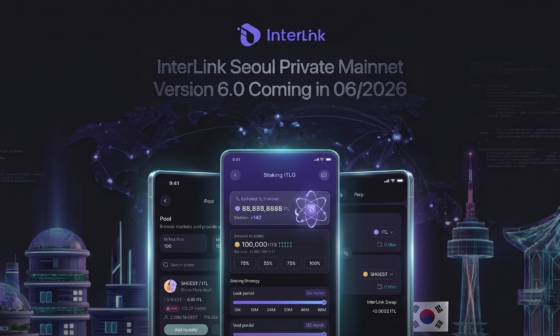
DAO Proposal 16 has officially reached its final verdict. The community has spoken, and Option 2 (Balanced Growth) emerged as the winning choice.
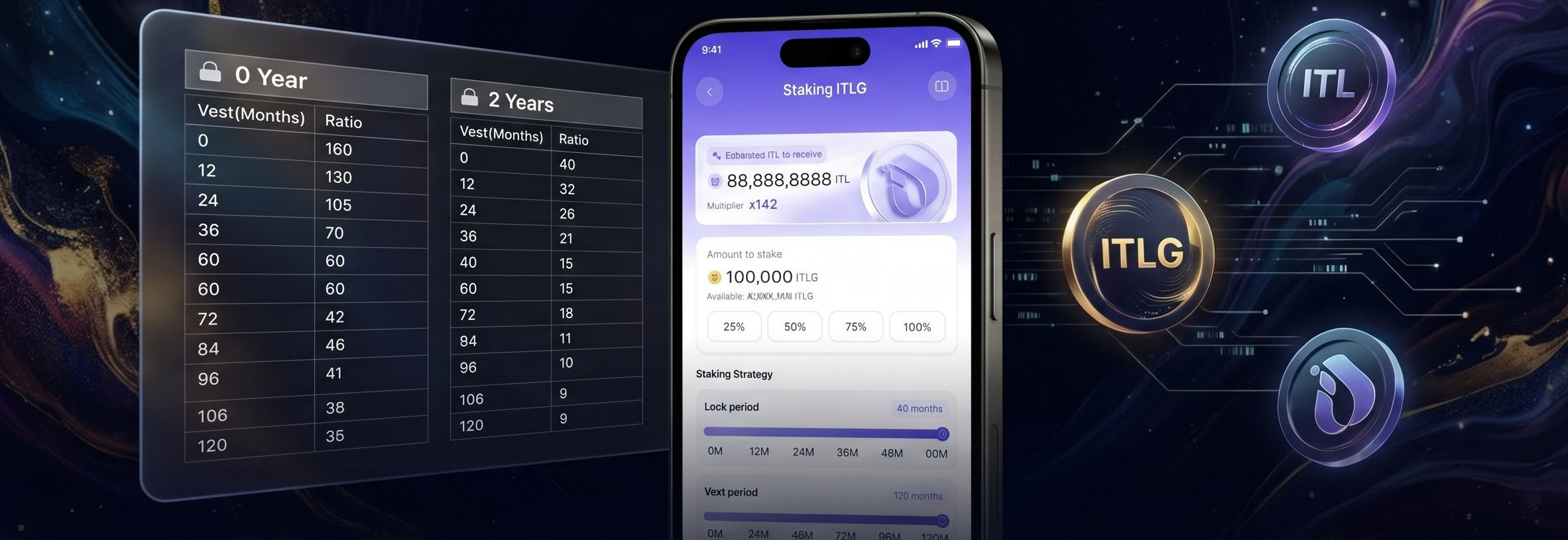
This decision establishes a highly dynamic conversion ratio: ranging from 1.125 ITLG / 1 ITL (for the maximum 5-year lock + 120-month vesting period) to 160 ITLG / 1 ITL (for the minimum 0-year lock + 0-month vesting period).
The community has voted. The protocol executes. Let’s dive into everything you need to know about this new staking mechanism.
🤖 Data-Driven Models Meet Community Governance
The final staking options weren’t pulled out of thin air. They were generated with the support of advanced Machine Learning (ML) models, built around three core pillars:
- Scarcity & Long-Term Sustainability: Safeguarding the token’s core value against long-term inflation.
- Optimal Circulating Supply: Ensuring enough market liquidity to support ecosystem absorption and utility.
- Anti-Price Manipulation: Protecting ecosystem participants from extreme market volatility.
However, AI didn’t make the rules. The machine learning models merely outlined the optimal financial frameworks, while the DAO community held the ultimate power to vote and decide the path forward.
⚖️ Why Option 2? The Power of “Balanced Growth”
Option 2 strikes the perfect equilibrium between aggressive ecosystem expansion and long-term token scarcity.
This approach ensures a healthy token flow to support real-world utility, payments, and dApp integration, while simultaneously maintaining sustainable deflationary pressures. This balance hardens ITL’s potential to evolve into both a highly efficient medium of exchange and a robust digital reserve asset.
💡 Crucial Note: Your ITLG never leaves your wallet and remains fully usable at all times. Only the newly generated ITL is subject to your chosen lock and vesting schedule.
📊 Real-World Scenarios (Based on 100,000 ITLG)
To give you a clear picture of how this works, here are three breakdown examples based on a 100,000 ITLG allocation:
| Metrics | Scenario 1: 0-Year Lock + 60-Month Vesting | Scenario 2: 2-Year Lock + 36-Month Vesting | Scenario 3: 5-Year Lock + 60-Month Vesting |
| Conversion Ratio | 60 ITLG $\rightarrow$ 1 ITL | 21.25 ITLG $\rightarrow$ 1 ITL | 1.875 ITLG $\rightarrow$ 1 ITL |
| Total ITL Received | ~1,667 ITL | ~4,706 ITL | ~53,333 ITL |
| Payout Timeline | Starts immediately | Starts after a 2-year lock | Starts after a 5-year lock |
| Monthly Release | ~28 ITL / month | ~131 ITL / month | ~889 ITL / month |
📌 Core Rules You Need to Know
- 100% Migration: vITLG and ITLG are fundamentally the same asset. All current ITLG holdings will be 100% migrated to the new system, rolling out in multiple phases over time.
- Maximum Flexibility: You don’t have to put all your eggs in one basket. Users can split their ITLG across multiple staking positions, customizing each with different lock and vesting combinations.
- Absolute Immutability: The moment you confirm your staking position, your payout timeline is permanently written into the smart contract. It becomes 100% immutable and cannot be altered by anyone—including the core team.
- Vesting Dynamics: After your chosen lock period ends, your ITL will either unlock instantly in full (if 0-month vesting is selected) or release linearly on a month-by-month basis according to your chosen vesting duration.
🚀 Conclusion
As @inter_link accelerates toward its highly anticipated Mainnet launch, engineering a bulletproof and sustainable tokenomics model remains our highest priority.
The ITLG-to-ITL conversion framework selected today is far from a temporary fix. It is the financial bedrock of the entire InterLink network, directly shaping:
- Circulating supply dynamics
- Protocol liquidity depth
- Ecosystem scaling velocity
- Long-term scarcity flywheels
- The future value proposition of ITL
The choices made today secure the economic resilience and scarcity of the InterLink ecosystem for years to come. Are you ready for Mainnet? Let us know which staking strategy you’re locking in down in the comments!