Real World Assets (RWA) are undergoing a massive transformation, evolving from a niche technological experiment into one of the most resilient and highly capitalized pillars of the global blockchain ecosystem. According to CoinGecko’s RWA 2026 Report, the total market size of this sector has officially crossed the $320 billion milestone.
So, what exactly is RWA, how does it work, and how is the market landscape shifting in 2026? Let’s dive deep into the details with NextGens Blog.
1. Understanding RWA and the Tokenization Process
Simply put, RWAs are digital tokens issued on a blockchain that represent ownership rights to tangible physical assets (such as gold and real estate) or traditional financial instruments (such as government bonds and equities).
This process of “on-chaining” assets is known as Tokenization. The workflow generally involves three rigorous stages:
- Off-Chain Structuring: To legally prepare the asset, it is isolated within a protective legal wrapper, such as a Special Purpose Vehicle (SPV). It is then managed by a regulated asset manager and safely stored by a licensed custodian to ensure the integrity of the off-chain collateral.
- Data and Valuation: The asset’s market value and legal titles are verified and audited to securely anchor the value of the digital token before issuance.
- On-Chain Token Issuance: Developers utilize smart contracts to “mint” (create) digital tokens on the blockchain. Each token represents a fractional share or a direct claim on the underlying physical asset.
A Prime Example: BlackRock’s BUIDL
Financial giant BlackRock purchases U.S. Treasury securities and places them into a dedicated fund (the SPV legal wrapper) safeguarded by BNY Mellon as the custodian. BlackRock then issues the BUIDL token on-chain. As the underlying bonds generate yield, that value is automatically distributed back to BUIDL token holders.
2. The RWA Market Landscape at a Glance (Q1 2026)
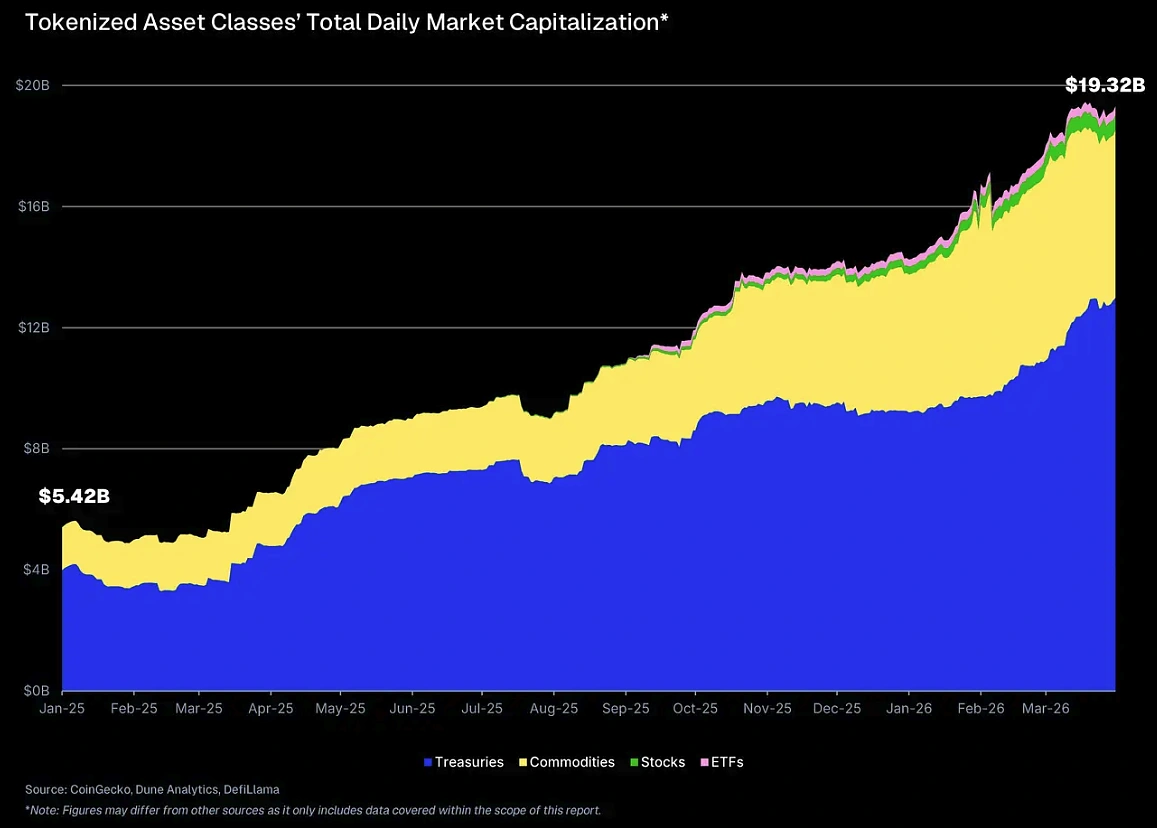
The RWA market is highly diversified and is no longer just a playground for stablecoins. Excluding fiat stablecoins, tokenized RWAs grew at a staggering rate of 256.7% over a fifteen-month period—surging from $5.42 billion at the start of 2025 to $19.32 billion by the end of Q1 2026.
Below is the market breakdown based on the latest data:
| RWA Category | Market Value (2026) | Leading Project / Asset | Primary Driver |
| Fiat Stablecoins | $301.65 Billion | USDT ($184.1B) / USDC ($77.4B) | On-chain liquidity demand |
| Tokenized Treasuries | $12.99 Billion | Circle USYC ($2.69B) / BlackRock BUIDL ($2.17B) | Institutional-grade safe yield |
| Commodity Tokens | $5.55 Billion | Tether Gold XAUT ($2.52B) / PAX Gold PAXG ($2.32B) | Global gold price rally |
| Private Credit | $2.29 Billion | Maple Finance ($2.13B active loans) | Corporate & institutional lending |
| Tokenized Stocks | $486.69 Million | Circle, Tesla, Nvidia | Evolving regulatory clarity |
| Tokenized ETFs | $297.50 Million | Ondo SPDR S&P 500, iShares Silver Trust | On-chain TradFi access |
3. Key Benefits and Challenges
The Major Benefits:
- Unlocking “Real Yield”: Unlike the highly volatile and inflationary yields found in pure DeFi pools, RWAs provide stable cash flows tied to the traditional economy.
- Fractional Ownership: Multi-million dollar assets like commercial real estate or large gold bars can be digitally split into affordable fractions, allowing retail investors to participate with minimal capital.
- 24/7 Global Access: Blockchain infrastructure removes geographical barriers, enabling anyone anywhere in the world to instantly invest in U.S. stocks or government bonds.
The Challenges to Consider:
- Regulatory Compliance & Identity Verification: Because they are tied to real-world jurisdictions, most RWA protocols require strict KYC (Know Your Customer) and AML (Anti-Money Laundering) checks for purchasing and redeeming tokens.
- Centralized Counterparty Risk: Investors must trust centralized entities (issuers, auditors, and legal teams) to ensure that the on-chain tokens are legitimately backed by the physical assets as claimed.
- Governance Token Underperformance: A major paradox observed between 2025 and 2026 is that while the RWA market value boomed, the native governance tokens of RWA protocols crashed significantly—many shedding between -44.7% and -98.8% (including prominent names like Ondo and Mantra). This indicates that value is accruing directly to the underlying tokenized assets rather than the crypto narrative’s governance tokens.
4. 5 Major RWA Trends Shaping the Future
1. The Institutional Onslaught
Traditional financial (TradFi) titans are no longer just experimenting; players like Goldman Sachs, JP Morgan (with its MONY fund), and BNY Mellon have built persistent infrastructure for institutional custody and 24/7 settlement layers. The market now counts four tokenized treasury products that cross the $1 billion market cap threshold.
2. Rapid Progression of Global Regulations
In the U.S., the signing of the GENIUS Act established a federal framework for payment stablecoins, while the SEC’s official “Tokenization Statement” (January 2026) paved the way for traditional exchanges like Nasdaq to receive approval for natively integrating tokenized stocks and ETFs. In Europe, MiCA is fully active, and the European Central Bank (ECB) officially accepted certain DLT-issued assets as eligible collateral, seamlessly integrating tokenized assets into European monetary infrastructure.
3. Diverging Exchange Strategies
Crypto exchanges are expanding vertically rather than just listing tokens. Kraken acquired Backed Finance to bring tokenized equity issuance under its own roof, while Coinbase and Crypto.com acquired U.S.-licensed financial infrastructure to gain regulated access to real stocks and ETFs.
4. Explosion of the RWA Perpetuals Market
Alongside spot tokenization, a massive derivatives market has taken shape. In Q1 2026 alone, RWA perpetuals (Perps) trading volume reached $524.8 billion—completely eclipsing the $313 billion recorded across the entirety of 2025. This explosion has been largely driven by decentralized perpetual platforms like Hyperliquid.
5. Multi-Chain Expansion Erasing Ethereum’s Monopoly
Ethereum’s dominant share of the on-chain RWA market cap has dropped significantly from 93.4% to 61.1%. Liquidity is aggressively migrating to BNB Chain (BSC) (capturing a 20% market share following Circle’s USYC deployment) and Solana (surpassing $1 billion in RWA market cap as it successfully pivots toward institutional clients).
Conclusion
Real World Assets are successfully fulfilling their mission to bridge the gap between traditional finance and the decentralized on-chain world. With a massive market cap exceeding $320 billion, clear regulatory frameworks like MiCA, and the backing of institutional giants like BlackRock, the RWA sector is poised to build a highly transparent, efficient, and democratized global financial system.
Disclaimer: The projects mentioned in this article are for informational and illustrative purposes only and should not be taken as financial or investment advice. Always do your own research.